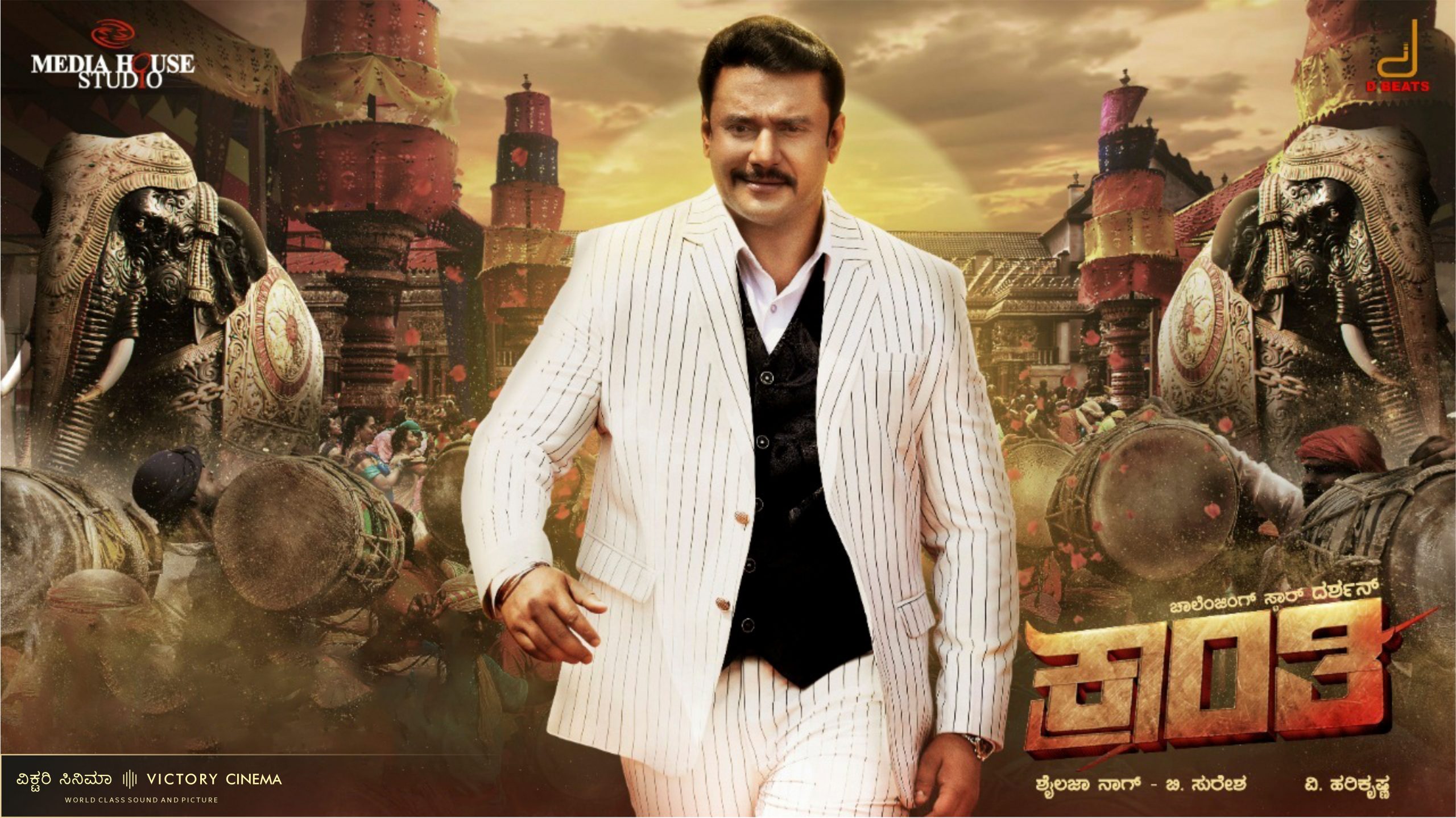
Kranti (Kannada With English Subtitles)
- Director: V Harikrishna
- Writers: V Harikrishna
- Stars:
- Darshan Thoogudeepa
- Rachitha Ram
- Dr V Ravichandran
- Sumalatha
Kranti at Victory Cinema Kranti brings Darshan to the big screen as Kranti Rayanna, a successful NRI businessman who returns to Karnataka and discovers that the government school responsible for shaping his childhood is facing a serious threat. What begins as a journey back to familiar people and memories soon becomes a fight involving education, political influence, corporate ambition and the future of thousands of children. Kranti has spent many years abroad building his reputation and business career. He returns when he is invited to attend the centenary celebration of the government school where he studied. The occasion should be a proud reunion, but he soon learns that the institution—and thousands of similar schools—may be closed or transferred into private control. Victory Cinema presents Kranti in Kannada with English subtitles for movie lovers from across Bengaluru and beyond. Written and directed by V. Harikrishna, the film stars Darshan and Rachita Ram alongside V. Ravichandran, Sumalatha, Tarun Arora, P. Ravi Shankar, Sampath Raj, Achyuth Kumar, Sadhu Kokila, Mukhyamantri Chandru and B. Suresha. Produced by Shylaja Nag and B. Suresha under Media House Studio, Kranti combines an education-centred social theme with romance, family emotion, comedy, political confrontation and large-scale action. Darshan as Kranti Rayanna Darshan plays Kranti Rayanna, a confident businessman who has achieved success outside India but continues to value the education and guidance he received during his childhood. Kranti is introduced as a man comfortable in international business environments. He possesses wealth, influence and the ability to respond decisively when faced with a challenge. However, the emotional foundation of his character remains connected to his family, teachers and school. Returning for the centenary celebration allows Kranti to revisit the institution that gave him opportunities when he was young. The journey also reveals how much has changed in his absence. Buildings have weakened, resources are limited and the survival of government schools has become uncertain. The role gives Darshan opportunities to combine style, humour, romance, emotional dialogue and mass action. Kranti can negotiate confidently with business leaders, speak directly to officials and physically confront people who attempt to silence him. His greatest strength, however, is his ability to turn an individual dispute into a wider movement. Once he understands that the problem affects thousands of schools, he recognises that protecting only his own institution will not be enough. A plan to privatise government education The central conflict begins with the Salatri Group, whose chief intends to take control of approximately 12,000 government schools. The proposed closures and transfers are presented as administrative or commercial decisions, but Kranti discovers a network of financial interests operating behind them. Tarun Arora appears as Salatri, the powerful businessman driving the plan. He sees educational institutions as opportunities for expansion and profit rather than public spaces created to serve children from every economic background. Salatri is supported by political and criminal forces prepared to influence government decisions, intimidate opposition and prevent inconvenient facts from becoming public. Kranti must therefore confront more than one individual. He faces a system involving business interests, corrupt officials and people capable of using violence when persuasion fails. The conflict gives the film a socially relevant foundation. Government schools represent access to education for families who may not be able to afford expensive private institutions. Closing them can affect children, teachers, villages and entire communities. The school that shaped Kranti The centenary celebration connects Kranti with the teachers and elders who influenced his childhood. Their memories remind him that success did not begin with wealth or an international business career. It began inside an ordinary classroom. V. Ravichandran plays Bhargava Rayanna, bringing seniority and emotional authority to Kranti’s family world. Mukhyamantri Chandru, Achyuth Kumar, B. Suresha and other experienced performers appear within the educational and social environment surrounding the hero. The older generation understands what government schooling once represented. Teachers worked with limited facilities but gave students discipline, knowledge and confidence. For Kranti, protecting these schools becomes a way of honouring the people who invested in his future before he possessed influence of his own. The school is therefore not merely a building threatened by a corporate takeover. It represents memory, equality and the belief that every child deserves an opportunity regardless of family income. Rachita Ram as Usha Rachita Ram plays Usha, bringing romance, humour and emotional warmth into Kranti’s journey. Her relationship with Kranti shows a lighter side of the businessman before the campaign to protect government schools becomes increasingly dangerous. Usha can respond to Kranti’s confidence with personality and humour of her own. Their exchanges give the film space for affection, colourful songs and playful situations amid the larger political conflict. Darshan and Rachita Ram reunite as an established Kannada screen pairing, allowing their scenes to balance familiarity with the scale of the central action drama. “Bombe Bombe” presents the lead pair through melody, romance and visually expansive settings. Their relationship also reminds audiences that Kranti has a personal life and future beyond the public fight he accepts. Political power and organised opposition Sampath Raj appears as Vaman Rao, a political figure connected to the effort to privatise the schools. P. Ravi Shankar brings intensity to the criminal side of the opposition, while Tarun Arora’s Salatri remains the principal corporate force. Each opponent represents a different barrier. Business influence controls money and planning. Political support can convert private ambition into official policy. Criminal power can frighten teachers, activists and families who attempt to resist. Kranti must understand how these forces work together before he can challenge them effectively. Wealth alone cannot solve the problem, because the opposing group possesses resources of its own. He requires public attention, evidence and the support of people who believe education should remain accessible. Sumalatha appears as the Chief Minister, placing a woman in the position where the government must hear competing arguments and determine whether the schools will be protected. The political sequences allow Kranti to move beyond physical confrontation and explain why public education matters. His campaign asks the administration to recognise the long-term consequences of treating schools only as financial assets. Education as a right and responsibility Kranti uses the commercial action-drama format to discuss the importance of government schools. The film asks what happens when quality education becomes available only to families capable of paying high fees. Parents often make enormous financial sacrifices to place children in private institutions because they fear government schools lack facilities or opportunities. Kranti argues that the answer is not to abandon public education but to improve it. Schools require classrooms, teachers, sanitation, technology, transport and consistent public support. When these institutions are strengthened, they can reduce the economic burden on parents and ensure that children from different backgrounds receive meaningful opportunities. The story also reminds successful former students that they can contribute to the institutions that helped them. Kranti’s return turns gratitude into action. He does not simply attend a celebration, deliver a speech and leave. He accepts responsibility for protecting the school’s future. V. Harikrishna’s social-action entertainer V. Harikrishna writes and directs Kranti while also composing its songs and background score. The film brings together a public-education theme and the familiar attractions of a Darshan-led theatrical entertainer. The approximately 163-minute runtime provides space for Kranti’s return, his romance with Usha, family relationships, the school’s history and the developing confrontation with Salatri’s organisation. A. Karunakar’s cinematography gives the movie a polished commercial scale. International settings, school environments, songs, political gatherings and action sequences each receive a distinct visual treatment. The action is designed around Kranti confronting organised groups rather than fighting for personal pride alone. Every major confrontation is connected to his attempt to expose the school-privatisation network and prevent intimidation. Production designer Shashidhar Adapa creates the contrasting environments of corporate wealth, political offices and government-school campuses, while the editing maintains the movement between social drama and mass entertainment. Music and theatrical energy V. Harikrishna’s soundtrack adds romance, celebration and heroic energy to the film. “Dharani” introduces a large and celebratory mood associated with Darshan’s screen presence. “Bombe Bombe,” sung by Sonu Nigam, brings melody to the relationship between Kranti and Usha. “Pushpavati” presents Darshan and Nimika Rathnakar in a colourful party number, while “Don’t Mess With Him” strengthens the action-oriented image of Kranti Rayanna. The background score supports Kranti’s entrances, public speeches and confrontations with the forces attempting to control the schools. Inside a cinema auditorium, the songs, dialogue and action create the collective excitement associated with a major Kannada star release. Kannada with English subtitles Victory Cinema presents Kranti in its original Kannada language with English subtitles. Audiences can experience Darshan’s dialogue delivery, Rachita Ram’s performance, Ravichandran’s emotional presence and the confrontations involving Tarun Arora, P. Ravi Shankar and Sampath Raj while clearly following every important exchange. The subtitles help viewers understand discussions about school administration, political decisions, business plans and public education. They make the film accessible to Bengaluru’s diverse moviegoing audience while preserving the rhythm and force of the original Kannada performances. The film carries a U/A classification and includes action violence, threats and politically charged confrontations. Parents may wish to consider its action intensity and extended runtime when booking for younger children. A Republic Day release for Bengaluru Kranti arrived in cinemas on January 26, 2023, aligning its education, public responsibility and social-change themes with the Republic Day holiday. Darshan’s return in a large-scale Kannada action role, his pairing with Rachita Ram, V. Harikrishna’s direction and music, and the presence of senior performers including Ravichandran and Sumalatha created substantial theatrical anticipation. Victory Cinema welcomes audiences from every part of Bengaluru to experience Kranti with the music, scale and shared energy of the big screen. Ranked #1 on Google for movie theatres in Bengaluru, Victory Cinema is a destination for major Kannada releases, family entertainers and socially relevant films presented through popular cinema. Booking directly through victorycinema.in allows moviegoers to check Kranti showtimes, choose preferred seats and complete their ticket booking without booking fees. Join Kranti’s revolution for education Kranti begins with a successful businessman returning to celebrate the institution that shaped his childhood. The visit becomes a much larger responsibility when he discovers that thousands of government schools and the futures of their students are under threat. Darshan’s commanding screen presence, Rachita Ram’s romance, Ravichandran’s emotional role, Sumalatha’s political authority and V. Harikrishna’s music come together in a Kannada action drama about education, gratitude and public responsibility. Watch Kranti in Kannada with English subtitles at Victory Cinema, Bengaluru. Check showtimes, select your preferred seats and book directly on victorycinema.in without booking fees. Join Kranti Rayanna as he challenges corruption, confronts a powerful privatisation network and begins a revolution to protect government schools and the children depending upon them.