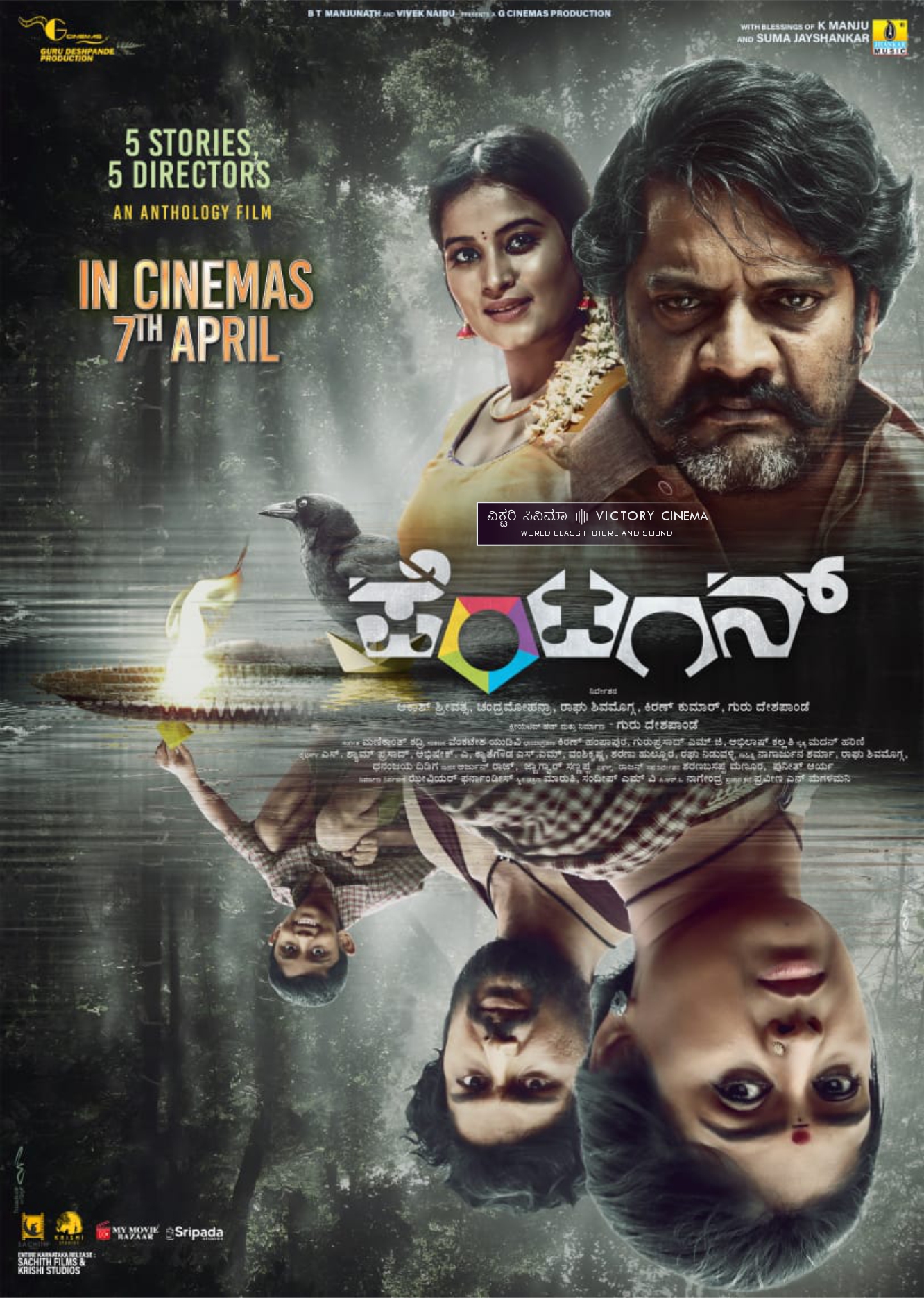
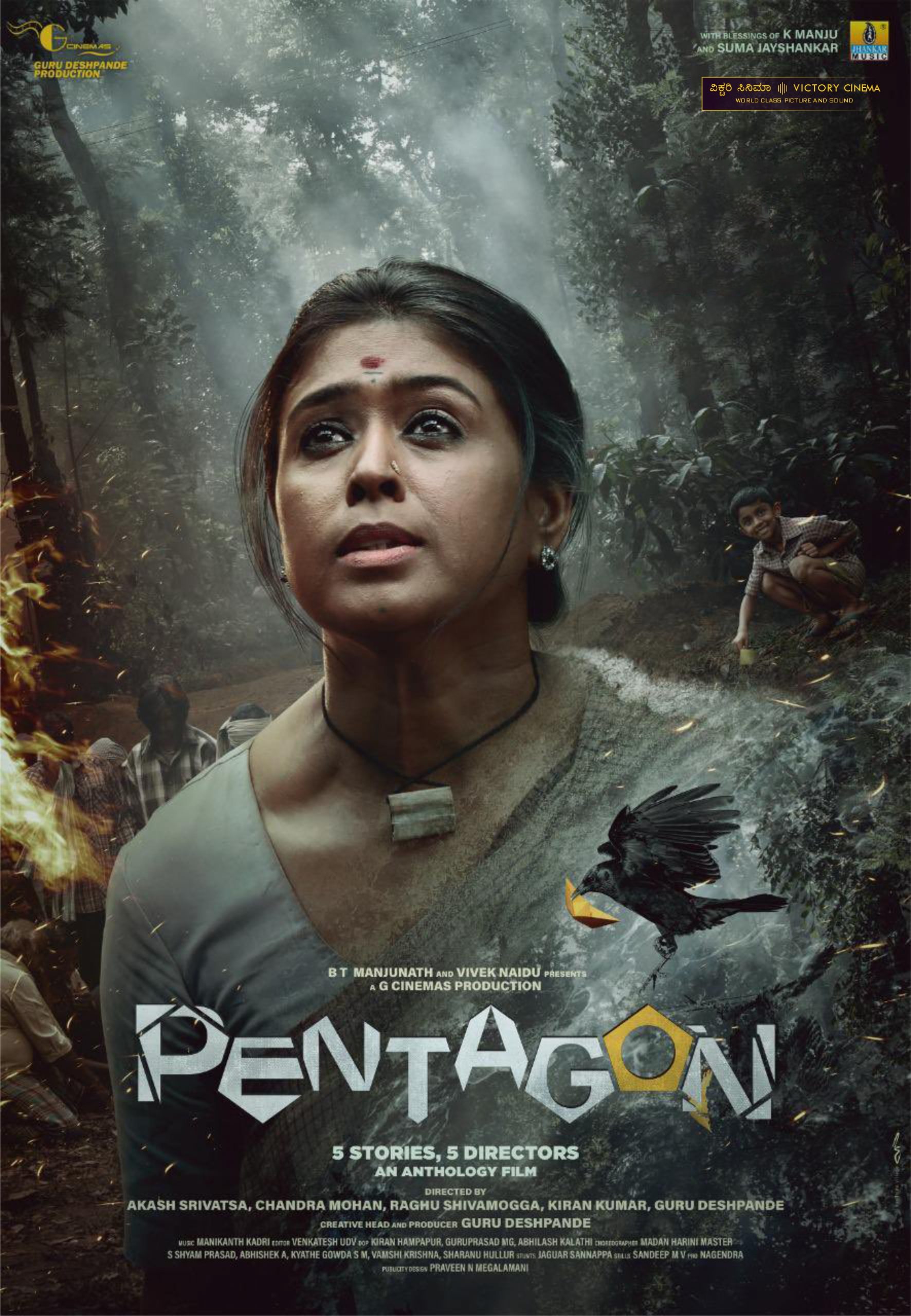
Pentagon (Kannada with English Subtitles)
- Director: Akash srivatsva ,Raghu shivamogga, Chandra mohan ,Guru Deshpande.
- Writers: S Shyam prasad, Abhishek A
- Stars:
- Kishore
- P Ravishankar
- Vijanath Biradar
- Pramod Shetty
Pentagon at Victory Cinema Pentagon brings five filmmakers, five groups of characters and five contrasting narrative worlds together within one ambitious Kannada anthology. Each chapter has its own setting, genre and emotional rhythm, yet all five stories are connected by reflections on life, death and the consequences created by seemingly ordinary human choices. The film moves from dark comedy and intimate family drama to cybercrime, social discrimination and political tension. Instead of following one hero through a conventional feature-length narrative, Pentagon gives audiences several self-contained experiences that gradually form a larger meditation on how people respond to loneliness, desire, ageing, prejudice, ambition and mortality. Victory Cinema presents Pentagon in Kannada with English subtitles for movie lovers from across Bengaluru and beyond. The anthology is directed by Chandra Mohan, Akash Srivatsa, Raghu Shivamogga, Kiran Kumar and Guru Deshpande, with an ensemble featuring Kishore, Pruthvi Ambaar, P. Ravi Shankar, Prakash Belawadi, Pramod Shetty, Vijanath Biradar, Sagar Gowda, Tanisha Kuppanda, Pritika Deshpande, Roopesh Rajanna and Ashwini Gowda. Produced by Guru Deshpande under G Cinemas, Pentagon offers an unusual theatrical platform for shorter stories while allowing each filmmaker to approach the common theme through a distinct cinematic style. Five stories connected by life and death The five sides of the title represent five different perspectives. Each chapter looks at individuals standing at a turning point where one decision can change several lives. Death forms the thematic connection, but Pentagon is equally concerned with the value and fragility of life. One story may approach the subject through dark humour, while another examines ageing, digital deception, caste inequality or public identity. This structure gives audiences variety without abandoning thematic unity. Characters from different economic, social and geographical backgrounds confront their own fears and desires, but each narrative asks a related question: how much do people understand the consequences of their actions before it becomes too late to reverse them? The anthology format also allows established performers and emerging artists to appear in roles shaped around one focused dramatic idea. Every chapter has limited time to introduce its world, create emotional involvement and lead the audience towards a meaningful conclusion. Mr Goofy’s Café Directed by Chandra Mohan, Mr Goofy’s Café enters the territory of dark comedy through a young man who has lost his enthusiasm for life. A painful romantic disappointment convinces him that his problems cannot be repaired, but his repeated attempts to end his life do not proceed according to plan. His desperation leads him towards an extraordinary solution involving another person hired to complete the task. What follows places a serious emotional condition inside an unpredictable situation where intention, chance and human connection begin interfering with one another. The chapter uses humour without ignoring the loneliness beneath the central character’s decisions. His belief that one personal loss has ended every possibility is challenged by circumstances that do not obey his carefully imagined plan. Pramod Shetty and the supporting performers bring nervous energy and dark humour to a story asking whether despair can remain certain when life continues creating unexpected encounters. Mysore Pak Akash Srivatsa directs Mysore Pak, an emotional chapter centred on Ramakant, a retired teacher played by Vijanath Biradar. Ramakant has reached a stage of life where his ordinary desires are easily overlooked. He misses the food he enjoys, particularly Mysore Pak, but his dependence upon family members makes even a simple craving difficult to satisfy. A meeting with a younger person introduces him to app-based food delivery, giving the elderly teacher a new sense of independence. Technology that appears routine to younger people becomes a small but meaningful discovery for someone accustomed to waiting for others. The chapter examines ageing, family attention and the quiet isolation that can exist inside a busy household. Ramakant’s love for a familiar sweet becomes a reminder that elderly people continue to possess preferences, dignity and emotional needs. Mysore Pak approaches the anthology’s larger theme through an ordinary domestic situation, showing how apparently minor acts of attention or neglect can carry profound consequences. Kamaturam Na Bhayam Na Lajja Raghu Shivamogga directs Kamaturam Na Bhayam Na Lajja, a contemporary chapter examining desire, dating applications and digital exploitation. Sagar Gowda and Tanisha Kuppanda appear as Anil and Jessi, whose interactions introduce the young man to an online world promising companionship, confidence and excitement. Dating applications can connect people who may never meet through traditional social circles, but anonymous digital communication also creates opportunities for deception. A person may construct an attractive identity, collect private information and exploit another individual’s loneliness or desire. The chapter moves from awkward humour towards psychological and criminal danger. Anil must recognise that the apparent intimacy created through a screen may be controlled by people whose intentions have little connection with affection. Its title suggests that uncontrolled desire may ignore both fear and shame. The story therefore functions as a warning about impulsive trust, intimate digital material and the sophisticated methods used by cybercriminals to manipulate vulnerable people. Doni Saagali Munde Hogali Kiran Kumar directs Doni Saagali Munde Hogali, a socially charged story examining caste discrimination, labour and unequal power. The chapter is set within an environment where a wealthy landowner possesses authority over people whose work supports his estate. P. Ravi Shankar appears as an influential Kodagu landlord, while Pritika Deshpande portrays a woman from a marginalised community employed as a labourer. The story focuses on the distance between people who may live and work near one another but are separated by deeply rooted social hierarchies. Economic dependence makes resistance difficult, while caste prejudice determines whose dignity is respected and whose pain is ignored. Prakash Belawadi adds further dramatic weight to a narrative dealing with power, privilege and the consequences of treating another human being as socially inferior. The chapter expands Pentagon beyond individual psychology and into structural injustice. Its conflict is not created by one misunderstanding alone but by attitudes passed through families, communities and institutions. Karma Guru Deshpande directs Karma, the anthology’s politically charged chapter featuring Kishore and Pruthvi Ambaar. Kishore plays Kadamba Ramachandrappa, a prominent pro-Kannada activist whose public identity brings influence, admiration and controversy. The story does not present activism through a simple heroic or villainous lens. Instead, it examines the contradictions surrounding a leader whose personal decisions, followers and public image may not always move in the same direction. Pruthvi Ambaar appears as a young man whose dissatisfaction becomes connected with the activist’s world. Rumours, allegations and competing loyalties begin affecting how people interpret both the leader and the movement associated with him. The chapter explores the difference between public reputation and private truth. A leader may be praised as a defender of language and identity while also facing questions about ambition, methods and responsibility. Karma asks how quickly followers can be divided when suspicion enters a movement. It also examines whether actions performed in the name of a larger cause remain beyond personal accountability. Roopesh Rajanna and Ashwini Gowda appear within this politically and culturally sensitive narrative, helping create the environment surrounding the activist and his supporters. Five directors and five cinematic approaches Pentagon allows each director to choose a style suited to the subject of the individual chapter. Chandra Mohan works with dark comedy and personal despair. Akash Srivatsa uses an intimate domestic setting to explore ageing and emotional neglect. Raghu Shivamogga enters the world of online desire and cyber manipulation. Kiran Kumar approaches caste and labour through social drama, while Guru Deshpande concludes with activism, public identity and political tension. The transitions between genres are part of the theatrical appeal. Audiences move through humour, sadness, suspense, discomfort and reflection without leaving the central thematic world. The ensemble format also means that no single performance carries the entire film. Experienced actors including Kishore, Ravi Shankar, Prakash Belawadi, Pramod Shetty and Vijanath Biradar appear alongside younger performers, giving every story a different personality. Manikanth Kadri’s thematic music Manikanth Kadri composed the music and background score, creating a musical connection across stories that differ greatly in setting and tone. Each chapter requires its own emotional language. Dark comedy needs a different rhythm from domestic tragedy, cybercrime or political drama. The score therefore responds to the geography, characters and subject of every segment while retaining a shared atmosphere. The central theme song, performed by Ananya Bhat with lyrics by Raghu Shivamogga, reflects the film’s interest in mortality. Its dark and contemplative sound connects the five stories and gives the anthology a recognisable musical identity. Inside a cinema auditorium, the background score helps audiences move between chapters while building suspense and emotional impact. Kannada with English subtitles Victory Cinema presents Pentagon in its original Kannada language with English subtitles. Audiences can experience the varied dialogue delivery and regional character of all five stories while following every important exchange. The subtitles are particularly valuable because the anthology moves through different social settings, professions and styles of speech. They help Bengaluru’s diverse moviegoing audience understand discussions involving family relationships, cybercrime, caste discrimination and language activism without reducing the impact of the original Kannada performances. The film carries an adult classification and deals with suicide, death, sexuality, exploitation, discrimination, strong language and mature social themes. It is intended for adult audiences. A distinctive Kannada anthology for Bengaluru Pentagon arrived in cinemas on April 7, 2023 as a rare Kannada anthology created for theatrical exhibition. Five filmmakers and a large ensemble come together to offer audiences several stories within one feature-length experience. Victory Cinema welcomes movie lovers from every part of Bengaluru to experience the film with the focus, sound and shared emotional response of the big screen. Ranked #1 on Google for movie theatres in Bengaluru, Victory Cinema is a destination for Kannada cinema, experimental storytelling and films that explore contemporary society through distinctive formats. Booking directly through victorycinema.in allows audiences to check Pentagon showtimes, select preferred seats and complete their ticket booking without booking fees. Discover the five sides of Pentagon Pentagon presents five lives, five conflicts and five approaches to the consequences of human behaviour. A disappointed young man, a retired teacher, a vulnerable digital user, a marginalised labourer and a public activist each confront circumstances capable of changing everything around them. Watch Pentagon in Kannada with English subtitles at Victory Cinema, Bengaluru. Check showtimes, choose your seats and book directly on victorycinema.in without booking fees. Experience five contrasting stories of humour, desire, loneliness, inequality, identity, life and death within one ambitious Kannada theatrical anthology.