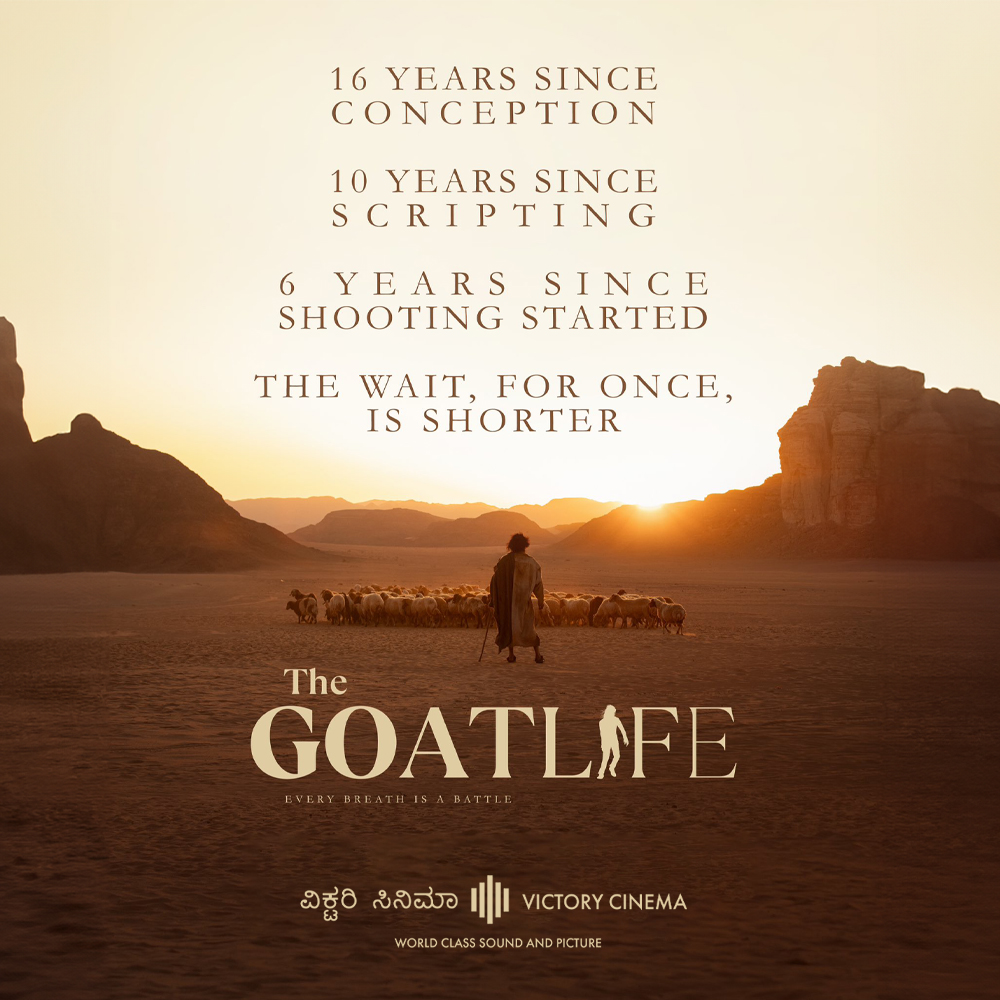
Aadujeevitham – The Goat Life (Malayalam with English Subtitles)
- Director: Blessy
- Writers: Benyamin
- Stars:
- Prithviraj Sukumaran
- Amala Paul
- Jimmy Jean-Louis
- Shobha Mohan
- A R Rahman
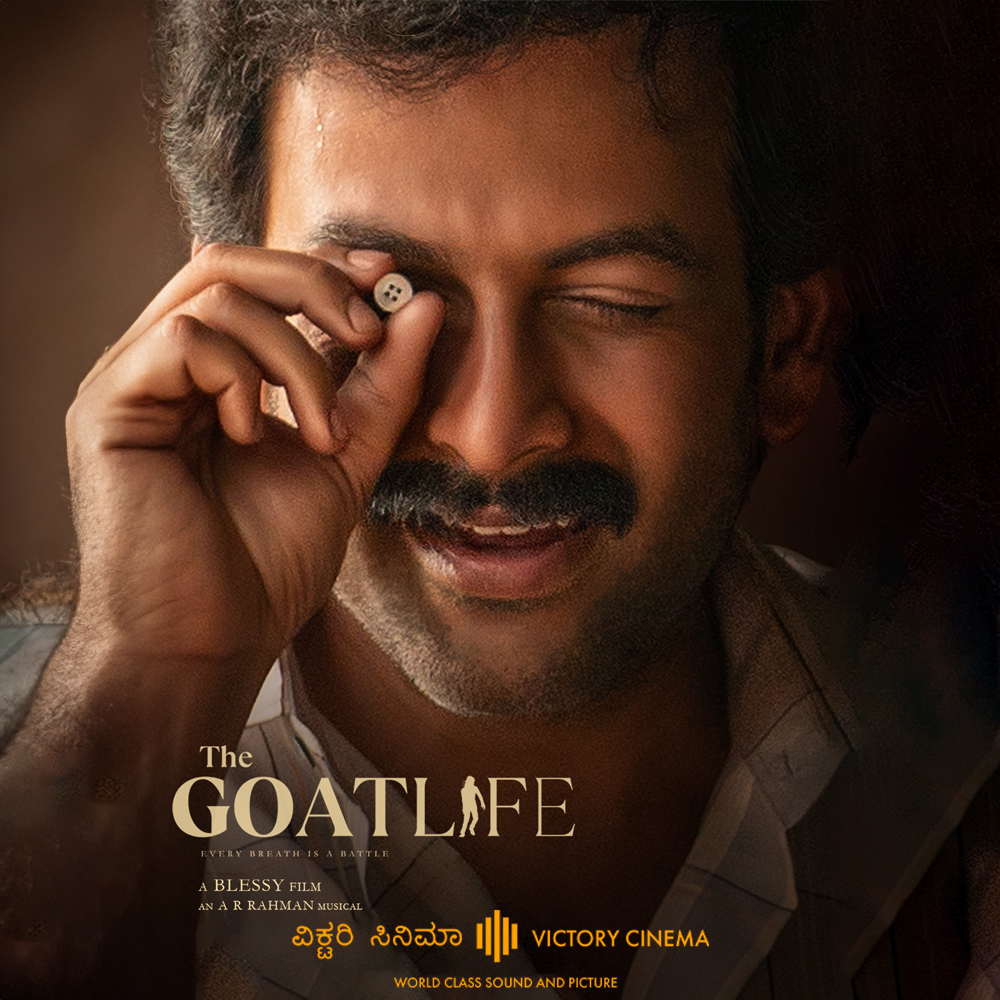
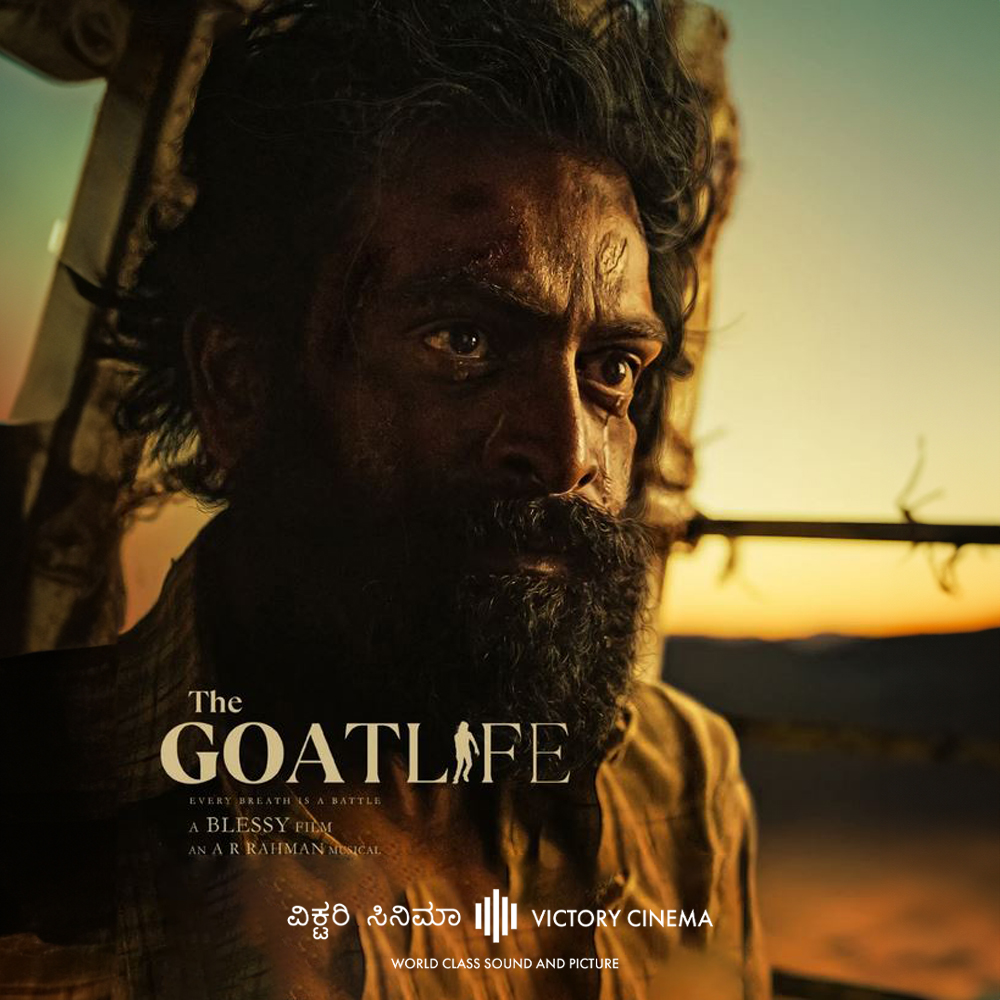
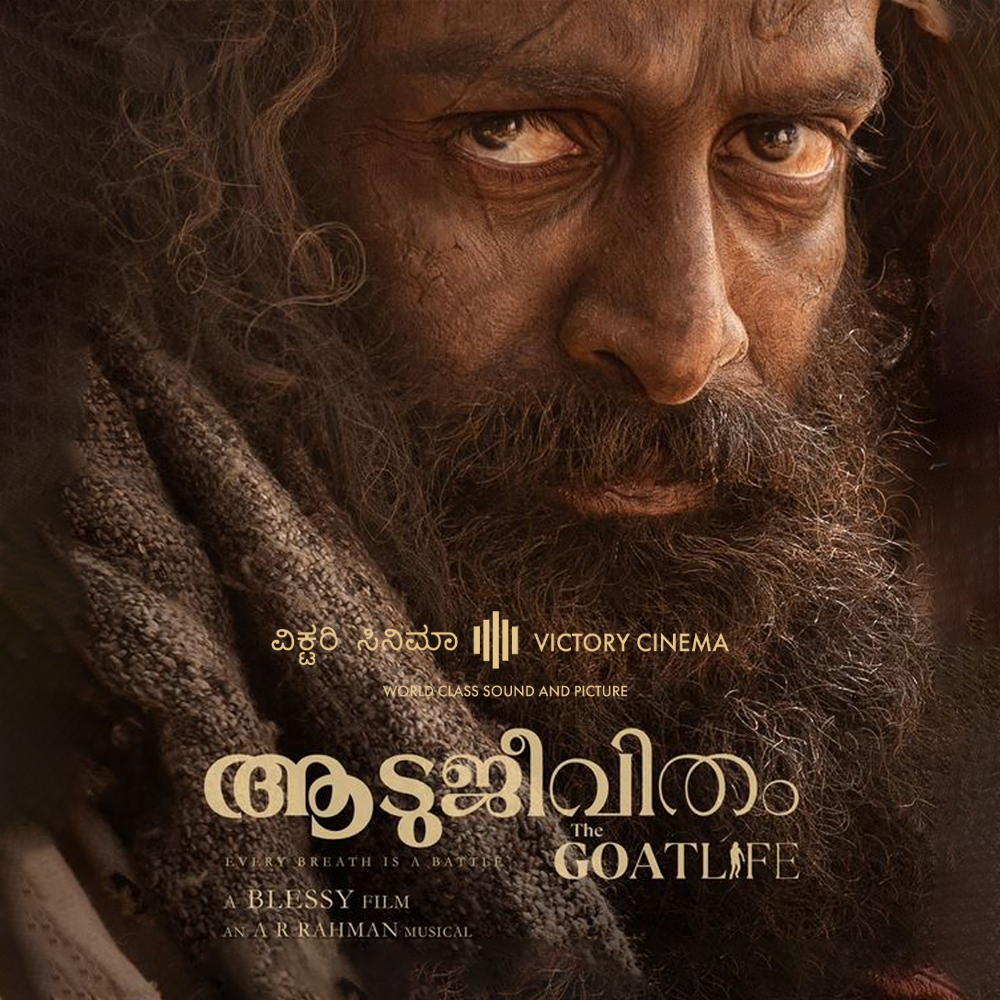
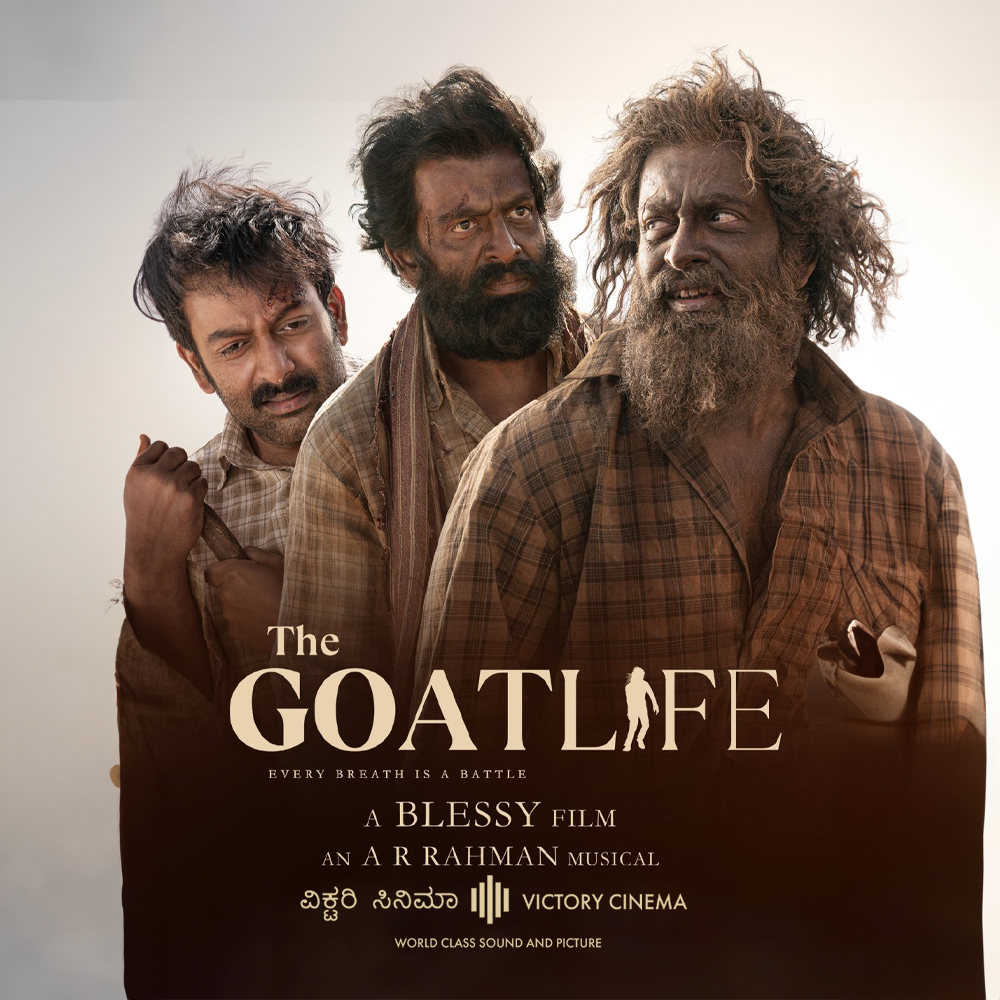
Aadujeevitham - The Goat Life at Victory Cinema Aadujeevitham - The Goat Life presents the extraordinary survival journey of Najeeb, a Malayali worker who leaves Kerala believing that employment in the Gulf will help him build a better future for his family. His expectations collapse when he is taken into an isolated desert and forced to work as a goatherd under cruel conditions, far from human companionship, legal protection and any familiar route home. Written, directed and co-produced by Blessy, the Malayalam survival drama is adapted from Benyamin’s acclaimed novel Aadujeevitham, which was inspired by the experiences of a migrant worker. Prithviraj Sukumaran leads the film as Najeeb, joined by Amala Paul, Jimmy Jean-Louis, K. R. Gokul, Talib Al Balushi and Rik Aby. The film releases worldwide on 28 March 2024. Victory Cinema presents Aadujeevitham - The Goat Life in Malayalam with English subtitles for audiences from across Bengaluru. Check showtimes, select your preferred seats and book directly on victorycinema.in without booking fees. Najeeb leaves home with a simple dream Najeeb’s journey begins with a hope shared by many people who travel abroad for employment. He wants honest work, a dependable income and the ability to provide security for his wife and family. Amala Paul plays Sainu, Najeeb’s wife and the emotional connection binding him to the life he leaves behind. Their relationship represents warmth, belonging and the future Najeeb expects to return to after completing his work abroad. The distance between expectation and reality gives the story its devastating force. Najeeb does not travel in search of adventure. He is an ordinary man following what appears to be an opportunity. Instead of reaching a recognised workplace, he is transported deep into an unfamiliar desert where language, geography and power are all working against him. The official synopsis describes an Indian man who travels for employment only to be forced into unpaid labour as a goat herder in a remote desert. Prithviraj Sukumaran as Najeeb Prithviraj Sukumaran undertakes one of the most demanding roles of his career as Najeeb. The character’s transformation cannot be communicated through dialogue alone. Hunger, exposure, isolation and years of physical labour must become visible through his body, movement, face and voice. Najeeb begins as a hopeful man surrounded by family and familiar landscapes. The desert gradually strips away the signs of that earlier life. Clothing deteriorates, hair and beard grow uncontrolled, and the body changes under inadequate food, extreme temperatures and exhausting work. Prithviraj’s performance follows Najeeb’s psychological transformation as closely as his physical decline. At first, he attempts to understand the situation and search for a practical escape. As isolation continues, survival becomes a daily struggle involving water, shelter, food and the need to preserve some connection to his human identity. The film was promoted before release as a deeply meditative character study, with Prithviraj explaining that Najeeb’s internal journey was as important as the vast desert spectacle surrounding him. A life among goats The title Aadujeevitham, meaning approximately “goat life,” reflects the disturbing transformation at the centre of Najeeb’s existence. Cut off from ordinary society, he spends his days herding goats across the desert. The animals become his only continuous companions. He learns their movements, responds to their needs and shares the harsh environment in which they survive. The relationship is not presented as a cheerful connection between a man and animals. It reveals the extent to which Najeeb has been removed from ordinary human life. His captor treats him as labour rather than as a person, while the goats receive the care required to preserve their economic value. Najeeb’s struggle is therefore physical, emotional and spiritual. He must keep working while carrying the knowledge that his wife and family do not know where he has disappeared. The open desert appears endless, yet it functions like a prison without visible walls. Talib Al Balushi as the Kafeel Talib Al Balushi plays the Kafeel, the man who controls Najeeb’s movements and labour in the desert. His authority comes from isolation, violence and Najeeb’s inability to communicate effectively or seek outside help. The Kafeel represents a system in which a migrant worker can be separated from documentation, transportation and contact with the outside world. Najeeb cannot simply resign, walk away or report his treatment. Every attempt to resist carries the threat of punishment or death. The character’s presence gives the film a constant sense of danger even during apparently quiet moments. Najeeb must observe his captor’s routines, understand the geography around him and wait for an opportunity that may never come. Prithviraj Sukumaran, Talib Al Balushi, K. R. Gokul, Jimmy Jean-Louis, Amala Paul and Rik Aby form the film’s principal ensemble. Hakim and Ibrahim Khadiri K. R. Gokul plays Hakim, another young migrant whose circumstances connect him to Najeeb’s struggle. Hakim’s presence reminds Najeeb that he is not the only worker whose hope of employment has been turned into exploitation. Jimmy Jean-Louis appears as Ibrahim Khadiri, a figure who becomes important to the possibility of crossing the desert and reaching freedom. His experience, endurance and understanding of the landscape offer something that Najeeb cannot develop alone. These relationships give the survival story another dimension. Isolation has damaged Najeeb’s ability to imagine escape, but companionship can restore purpose. The men must depend upon one another while facing thirst, exhaustion, heat and a landscape offering almost no protection. The film’s principal dramatic question is not simply whether Najeeb can leave the goat farm. Escaping the immediate captor still means crossing an enormous desert without dependable food, water or transportation. Blessy’s long-awaited adaptation Director Blessy began pursuing an adaptation of Benyamin’s novel many years before the film reached theatres. The project demanded desert locations, substantial physical preparation and a production scale difficult to achieve within an ordinary schedule. Filming commenced in 2018 and continued across several schedules until 2022. Important desert portions were filmed in Jordan and Algeria, while other scenes were completed in Kerala. Production was further complicated when the cast and crew became stranded in Jordan during the COVID-19 restrictions. That extended production journey reflects Blessy’s determination to create a physically convincing environment around Najeeb. The desert is not treated as a picturesque backdrop added behind the performer. It determines how the character walks, works, sleeps and searches for hope. The film consequently promises an immersive experience shaped by scale, silence and close attention to one man’s changing relationship with the environment. The desert as prison and landscape Sunil K. S. handles the cinematography, capturing both the beauty and terror of the desert. Wide images can reveal immense dunes, open skies and distant horizons, but that beauty becomes frightening when viewed through the experience of someone trapped without water or direction. A landscape with no walls may still offer no meaningful freedom. Every path looks similar, landmarks disappear and distance becomes almost impossible to judge. The cinematography must move between the enormous scale of the desert and the smallest details of survival: cracked skin, limited water, damaged feet, the movement of goats and the changing condition of Najeeb’s body. A. Sreekar Prasad serves as editor, while Resul Pookutty contributes to the film’s sound design. Their work supports a narrative where silence, breathing, wind and distant animal sounds can communicate isolation as powerfully as dialogue. A. R. Rahman’s music A. R. Rahman composes the songs and original score, giving Najeeb’s journey a musical language shaped by longing, spirituality, memory and survival. “Omane,” performed by Vijay Yesudas, Chinmayi Sripada and Rakshita Suresh, carries the tenderness of Najeeb’s relationship with Sainu and the life he remembers in Kerala. “Periyone,” sung by Jithin Raj, brings prayer, surrender and spiritual yearning into the desert. Rather than overwhelming Najeeb’s struggle with conventional spectacle, the song is shaped around the emotional loneliness of a man searching for strength beyond his immediate circumstances. The soundtrack also includes “Benevolent Breeze,” the Palestinian folk piece “Badaweih” and “Istigfar.” The album was released before the theatrical opening through Visual Romance Music. Rahman’s score promises to connect the beauty of the landscape with the pain of Najeeb’s isolation, making music part of his memory, faith and determination to remain alive. Malayalam with English subtitles Victory Cinema presents Aadujeevitham - The Goat Life in its original Malayalam-language version with English subtitles. The subtitles allow audiences to experience Prithviraj Sukumaran and Amala Paul’s original dialogue delivery while clearly following Najeeb’s conversations, memories and encounters with people speaking different languages. They are particularly useful in a film where communication itself becomes part of the danger. Najeeb’s inability to understand the people controlling him deepens his helplessness, while exchanges between migrant workers may contain vital information about survival and escape. The Malayalam presentation retains the cultural identity of Najeeb’s home, his relationship with Sainu and the emotional meaning of the memories that sustain him in the desert. A 173-minute survival drama Aadujeevitham - The Goat Life has an approximate running time of two hours and fifty-three minutes and is classified as an adventure drama with a U/A certificate. The extended running time gives Blessy space to show transformation gradually. Najeeb’s condition cannot change convincingly through a few brief scenes. Audiences must experience repetition, waiting, failed hope and the immense passage of time. The film moves between Kerala’s greenery and the desert’s unforgiving openness, creating a visual and emotional contrast between home and captivity. Its scale makes the theatrical environment especially important. The dunes, changing weather, detailed soundscape and A. R. Rahman’s music are designed to surround the audience while Prithviraj’s performance keeps the experience grounded in one individual’s struggle. An unforgettable theatrical journey for Bengaluru Aadujeevitham - The Goat Life is created for audiences who appreciate survival dramas, literary adaptations, emotionally demanding performances and stories about ordinary people placed in extraordinary circumstances. Najeeb does not possess weapons, wealth or institutional support. His strength lies in endurance, memory and the refusal to abandon the possibility of freedom. The film also speaks to the hopes carried by migrant workers who leave home believing that foreign employment will transform their families’ lives. Najeeb’s experience turns that hopeful journey into a nightmare, but his attachment to home remains a source of emotional resistance. Victory Cinema welcomes Prithviraj Sukumaran fans and Malayalam movie lovers from every part of Bengaluru to experience this ambitious survival drama on the big screen. Check Aadujeevitham - The Goat Life showtimes, choose your preferred seats and book directly on victorycinema.in without booking fees. Walk with Najeeb through the desert Najeeb enters the desert believing that his employment is the beginning of a better life. Instead, he is deprived of freedom, companionship and the ability to contact the people waiting for him. Survival demands that he adapt to brutal conditions without allowing the desert to erase his identity. Escape demands courage, companionship and the willingness to cross a landscape that appears determined to defeat every traveller. Watch Aadujeevitham - The Goat Life in Malayalam with English subtitles at Victory Cinema, Bengaluru. Experience Prithviraj Sukumaran’s transformative performance, Blessy’s long-awaited adaptation, A. R. Rahman’s evocative music and a powerful cinematic journey through loneliness, endurance, faith and hope