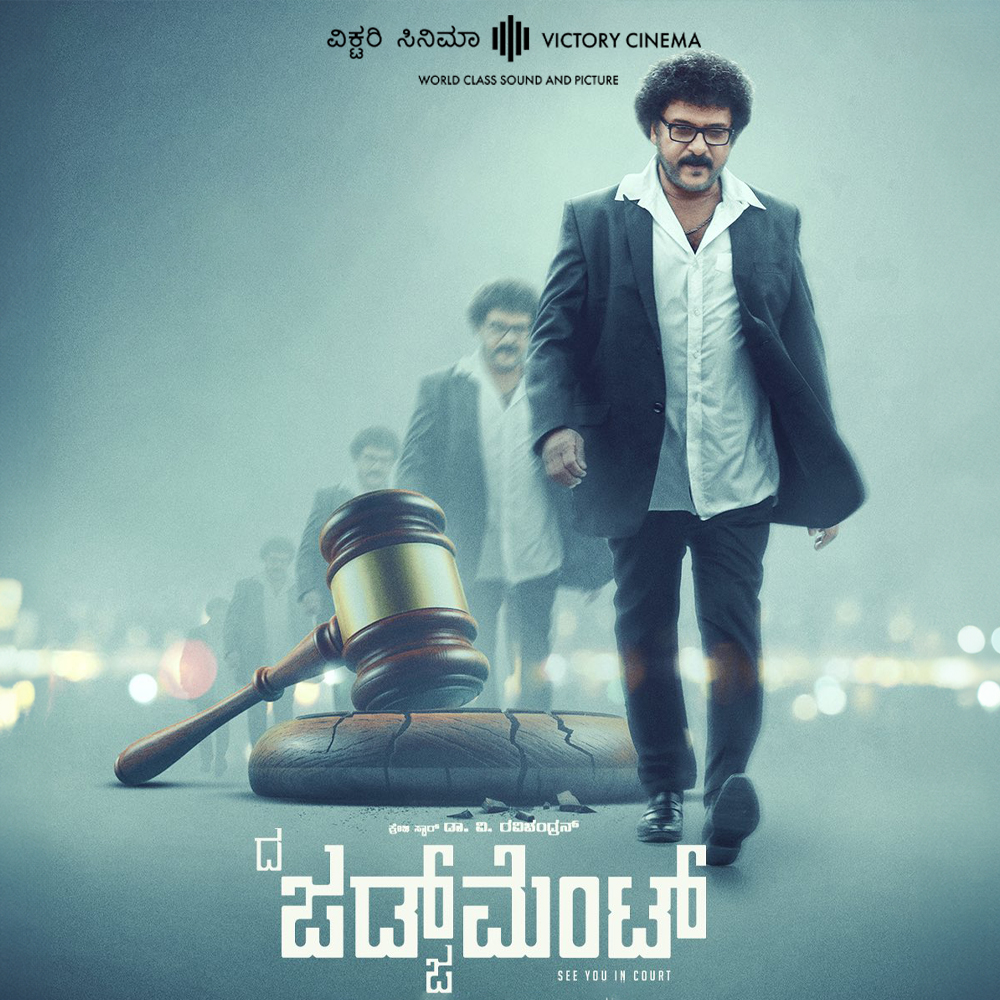
The Judgement (Kannada with English Subtitles)
- Director: Gururaj Kulkarni Nadagoud
- Writers: Gururaj Kulkarni Nadagoud
- Stars:
- V. Ravichandran
- Diganth
- Meghana Gaonkar
- Dhanya Ramkumar
- Lakshmi Gopalaswamy
- T.S. Nagabharana
- Prakash Belawadi
- Rangayana Raghu
The Judgement at Victory Cinema The Judgement is a Kannada courtroom thriller centred on Govind Prasad, a highly successful criminal lawyer whose professional choices lead him towards a profound ethical crisis. After recognising that one legal victory may have produced a grave injustice, Govind begins an internal and professional journey to correct his mistake without stepping outside the legal system he has spent his career serving. V. Ravichandran leads the film as advocate Govind Prasad, with Diganth, Meghana Gaonkar, Dhanya Ramkumar, Lakshmi Gopalaswamy, Prakash Belawadi, T. S. Nagabharana, Rangayana Raghu, Ravishankar Gowda and Krishna Hebbale forming the ensemble. Written and directed by Gururaj Kulkarni Nadagoud, the film releases theatrically on 24 May 2024. BookMyShow lists the Kannada drama-thriller with a U/A certificate and an approximate running time of two hours and thirty-one minutes. Victory Cinema presents The Judgement in Kannada with English subtitles for audiences from across Bengaluru. Check the latest showtimes, select your preferred seats and book directly on victorycinema.in without booking fees. Govind Prasad enters an ethical crisis Govind Prasad is recognised as a formidable criminal lawyer. His professional confidence comes from experience, preparation and an ability to construct persuasive arguments within the courtroom. The legal profession has rewarded his sharpness, but one case forces him to reconsider the difference between winning and securing justice. The film’s official synopsis describes the internal journey of a successful lawyer who decides to correct his own mistakes while facing ethical dilemmas and complex legal obstacles. His decision ultimately carries consequences extending beyond his personal life and affecting society at large. This premise gives The Judgement a conflict that is both legal and deeply personal. Govind does not begin as an outsider exposing a system he has never trusted. He is an accomplished participant in that system, and his crisis arises because he understands how effectively legal procedure can produce a result without necessarily revealing the complete truth. Correcting the mistake may threaten his professional standing, reputation and confidence in his own judgement. Yet ignoring it would mean accepting that courtroom success matters more than the fate of the person affected by his arguments. Diganth as Anil Diganth plays Anil, an investment banker drawn into a murder case after meeting a client. Circumstances place him under suspicion, and the legal process begins moving rapidly around an accusation capable of changing his entire life. Govind is professionally connected to the proceedings that lead towards Anil’s conviction. The case appears to reach a legal conclusion, but the advocate’s instincts and conscience continue troubling him after the courtroom has delivered its answer. The central mystery therefore does not depend only upon whether a crime occurred. It asks whether the person punished by the system is truly responsible and whether an advocate who later develops doubts has a duty to reopen questions everyone else considers settled. Diganth’s role gives the legal drama its immediate human stakes. An accused person can be reduced inside a case file to statements, evidence and arguments, but the outcome affects a living individual whose liberty, relationships and future depend upon the court’s conclusion. Justice must remain within the law Director Gururaj Kulkarni has described The Judgement as a film about a protagonist who continues seeking justice within the established legal framework, even after facing serious obstacles. The story does not turn Govind into a vigilante who abandons court procedure once the system becomes inconvenient. He remains committed to legal remedies, investigation, argument and due process. The film consequently presents the law not as something that must be rejected, but as a system whose integrity depends upon the people working within it. That distinction gives the film a different dramatic tension from an ordinary revenge story. Govind cannot simply identify an opponent and confront that person through force. He must obtain information that can survive scrutiny, understand how the earlier proceedings went wrong and find a lawful route towards correction. The courtroom becomes a place where language, evidence and interpretation can determine freedom. Every statement matters, and every attempt to repair the case must meet the same standards that helped create the original result. V. Ravichandran in a courtroom role The Judgement presents V. Ravichandran in the role of an advocate whose authority comes from intelligence and legal experience rather than physical action. Govind must appear convincing when he argues before a judge, but the more demanding performance begins when certainty gives way to doubt. A lawyer known for professional confidence is forced to examine whether his own skill contributed to an unjust result. Ravichandran’s presence gives the character stature while allowing the film to explore regret, responsibility and redemption. Govind’s journey is not about discovering that the law is simple. It is about accepting that legal professionals must remain accountable for the consequences of their work. The director identified Ravichandran’s advocate as a protagonist committed to finding solutions within the judicial system. This gives the actor a character who must combine courtroom command with quieter moments of moral reflection. Lakshmi Gopalaswamy as an opposing lawyer Lakshmi Gopalaswamy appears in a strong role as a lawyer standing on the opposing side of the legal proceedings. Her character ensures that Govind’s arguments are tested rather than accepted without challenge. A courtroom thriller requires more than one persuasive voice, because the truth must emerge through competing interpretations of evidence and responsibility. Gururaj Kulkarni specifically highlighted Lakshmi Gopalaswamy’s role as an opposing advocate while discussing the film’s substantial female characters. The legal confrontation is therefore not presented as a simple division between an intelligent hero and incompetent opponents. Each side has professional duties, strategies and an understanding of the material placed before the court. This opposition also places Govind under additional pressure. He must confront the consequences of his earlier work while persuading legal professionals who may reasonably question why his position has changed. Meghana Gaonkar and Dhanya Ramkumar Meghana Gaonkar and Dhanya Ramkumar play significant roles within the ensemble surrounding Govind and Anil. Meghana was announced as Ravichandran’s onscreen pairing in the legal thriller, giving the story a relationship through which audiences can observe the personal impact of Govind’s professional crisis. A lawyer’s ethical dilemma does not remain inside the courtroom. The stress created by doubt, investigation and professional risk can affect the people closest to him. Those relationships give emotional meaning to legal decisions that might otherwise appear purely technical. Dhanya Ramkumar’s character also forms part of the principal story, contributing another perspective to a narrative in which women occupy consequential positions rather than appearing only around the central male characters. The director emphasised that the female performers were given significant parts in the film. Together, Meghana Gaonkar, Dhanya Ramkumar and Lakshmi Gopalaswamy expand the drama beyond a single advocate and accused person, showing how one case can affect families, colleagues and people whose lives intersect with the proceedings. A wider ensemble of experienced performers Prakash Belawadi, T. S. Nagabharana, Rangayana Raghu, Ravishankar Gowda, Sujay Shastry, Krishna Hebbale, Rekha Kudligi and other performers complete the supporting cast. Their presence suits a story involving courts, investigation, professional institutions and multiple versions of the same event. Judges, lawyers, witnesses, relatives and officials can each possess information capable of changing how the case is understood. Prakash Belawadi and T. S. Nagabharana bring particular authority to dialogue-driven material, while Rangayana Raghu and Ravishankar Gowda contribute the recognisable character energy associated with a large Kannada ensemble. The supporting characters also help establish that the consequences of Govind’s mistake extend beyond private guilt. The case may expose a wider problem involving the way influence, assumptions or incomplete evidence can shape a legal outcome. A courtroom thriller driven by dialogue The Judgement relies upon argument, questioning and revelation rather than constant physical action. M. S. Ramesh writes the dialogues, giving the courtroom exchanges a central role in the film’s suspense. The words chosen by an advocate can redirect attention, expose contradictions or create doubt about an apparently settled fact. The director’s stated intention is to examine the judicial system while recognising that external influences can sometimes create the impression that the system itself is inadequate. The film’s protagonist responds by working within legal procedure rather than rejecting it. This approach makes attentive viewing especially rewarding. A line delivered during an early hearing may acquire new meaning when additional information emerges. A confident statement may later appear incomplete, while a detail initially treated as minor may become central to Govind’s search. The courtroom scenes promise strategic exchanges between experienced performers, with professional restraint gradually giving way to moral urgency as the implications of the case become clearer. Gururaj Kulkarni’s legal drama Gururaj Kulkarni Nadagoud writes the story and screenplay in addition to directing the film. He also produces the project through G9 Communication Media and Entertainment, with Reliance Entertainment handling distribution. His central creative choice is to build the hero’s journey around accountability. Govind’s status does not protect him from self-examination. Instead, his knowledge of the law makes it impossible for him to ignore the possibility that the wrong person may have suffered because of his work. The title The Judgement refers not only to a court’s formal decision. It also suggests Govind’s judgement as an advocate, society’s judgement of the accused and the personal judgement he must pass upon his own actions. The subtitle used during promotion, “See You in Court,” reinforces the film’s commitment to legal confrontation as the arena in which the conflict must ultimately be addressed. Cinematography, editing and music P. K. H. Das handles the cinematography, Kemparaj serves as editor and Anoop Seelin composes the music. These technical credits were confirmed by the director’s pre-release interview. The visual presentation must give weight to courtrooms, offices and formal spaces without making a dialogue-led film appear static. Framing can reveal who controls a conversation, which character is under pressure and how the balance within the courtroom changes as new information emerges. Editing becomes especially important when the narrative moves between earlier proceedings, Govind’s developing doubts and his effort to reconstruct what truly happened. The audience must understand the legal sequence while remaining uncertain about the complete answer. Anoop Seelin’s music supports the emotional and suspenseful dimensions of the story. The score can distinguish between public courtroom confidence and Govind’s private sense of responsibility, allowing the same character to appear professionally composed while internally unsettled. Kannada with English subtitles Victory Cinema presents The Judgement in its original Kannada-language version with English subtitles. Audiences can experience Ravichandran, Diganth, Meghana Gaonkar, Dhanya Ramkumar, Lakshmi Gopalaswamy and the wider ensemble in their original voices while following every legal argument clearly. English subtitles are particularly valuable in a courtroom film because meaning often depends upon precise wording. Questions, objections, evidence and professional terminology must be understood accurately for the audience to follow how one argument challenges another. The subtitles also make the film accessible to Bengaluru audiences from different linguistic backgrounds while preserving the performance style and emotional rhythm of the Kannada dialogue. A Kannada courtroom thriller for Bengaluru The Judgement is created for viewers who enjoy legal dramas, moral dilemmas, murder mysteries and character-driven thrillers. Rather than presenting justice as an easy victory, the film examines what happens when a respected lawyer begins questioning the result he helped produce. Govind must choose between protecting his reputation and accepting responsibility for a mistake whose consequences may extend across society. V. Ravichandran leads an experienced ensemble, while Diganth’s Anil gives the case its human urgency. Lakshmi Gopalaswamy brings strength to the opposing legal position, and Meghana Gaonkar, Dhanya Ramkumar, Prakash Belawadi, T. S. Nagabharana and Rangayana Raghu broaden the emotional and institutional world of the film. Victory Cinema welcomes Kannada movie lovers and courtroom-thriller audiences from every part of Bengaluru to experience The Judgement on the big screen. Check the latest showtimes, select your preferred seats and book directly on victorycinema.in without booking fees. When winning a case is not the end Govind Prasad knows how to persuade a courtroom and obtain a decisive result. His greatest challenge begins after the judgement, when professional success gives way to the possibility that the truth has not been fully discovered. To correct the mistake, he must place his reputation, judgement and understanding of justice under examination while remaining faithful to the law. Watch The Judgement in Kannada with English subtitles at Victory Cinema, Bengaluru. Experience V. Ravichandran in a morally complex advocate role, supported by Diganth, Meghana Gaonkar, Dhanya Ramkumar, Lakshmi Gopalaswamy and an accomplished ensemble in a courtroom thriller about truth, accountability and redemption.